


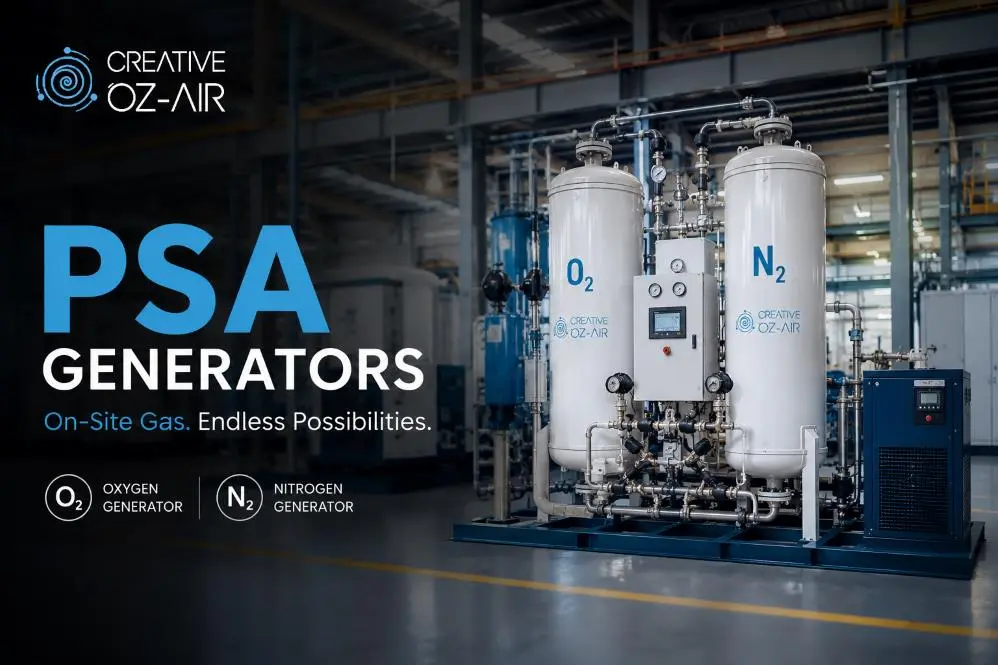
A PSA Generator is a machine that separates specific gas species (Oxygen or Nitrogen) from compressed air.
The system uses special filter material, known as adsorbents (such as zeolites or activated carbon), to selectively target and trap secondary gases.
Instead of storing gas in cylinders or cooling air to extreme sub-zero temperatures, a PSA unit produces gas continuously, on-site, using nothing more than compressed air and electricity.
It is simple in concept yet precise in implementation, which is why it has become the industrial standard for medium to large gas demands.
PSA stands for Pressure Swing Adsorption. This is a modern technology for separating gases from the air.
It operates on the principle that gases adsorb onto the surface of a solid material at high pressure and detach when the pressure is reduced.
PSA technology was invented in 1958 by Dr Charles Skarstrom, who worked for the company Esso Research and Engineering.
Around the same time, two French scientists, Guérin de Montgareuil and Dominique Domine, independently discovered and patented this process as well.
In the 1970s, the German company Bergbau-Forschung manufactured and launched the first nitrogen generator on a commercial scale, utilizing Carbon Molecular Sieve (CMS) technology.
Every PSA generator — oxygen or nitrogen — runs on the same four-step cycle, known as the Skarstrom cycle, repeating continuously across two adsorption towers so that gas output never stops:
While one tower adsorbs, the other regenerates – this alternating handover is what makes PSA output continuous instead of batch-based.
Based on the adsorbent material used and the gas produced, PSA generators are primarily of two types:
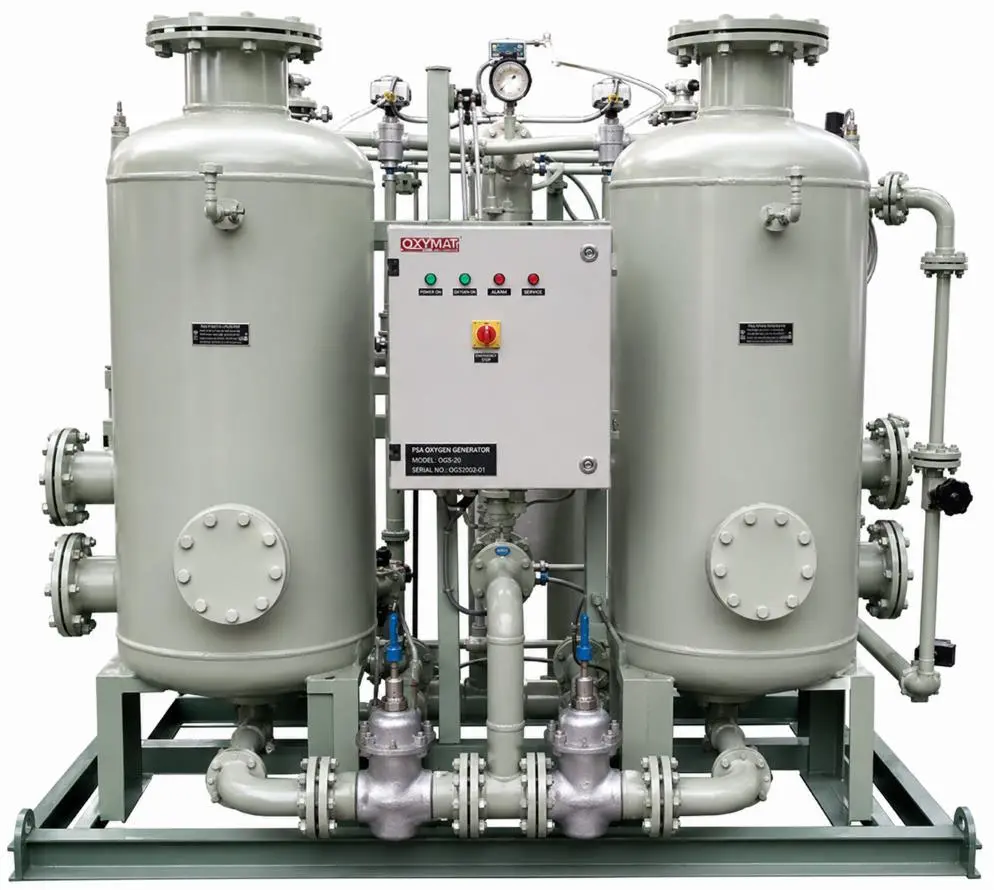
A PSA oxygen generator separates oxygen from compressed atmospheric air; this air contains approximately 78% nitrogen and 21% oxygen.
The system typically uses a zeolite molecular sieve (ZMS) that absorbs nitrogen, allowing oxygen-rich gas to pass through.
PSA oxygen systems are commonly used where a continuous on-site oxygen supply is required, including water treatment, ozone generation, aquaculture, glass processing, and selected industrial processes.
Typical output: Oxygen-enriched gas, usually around 93±2% (91-95%) O₂ depending on system design and operating conditions.
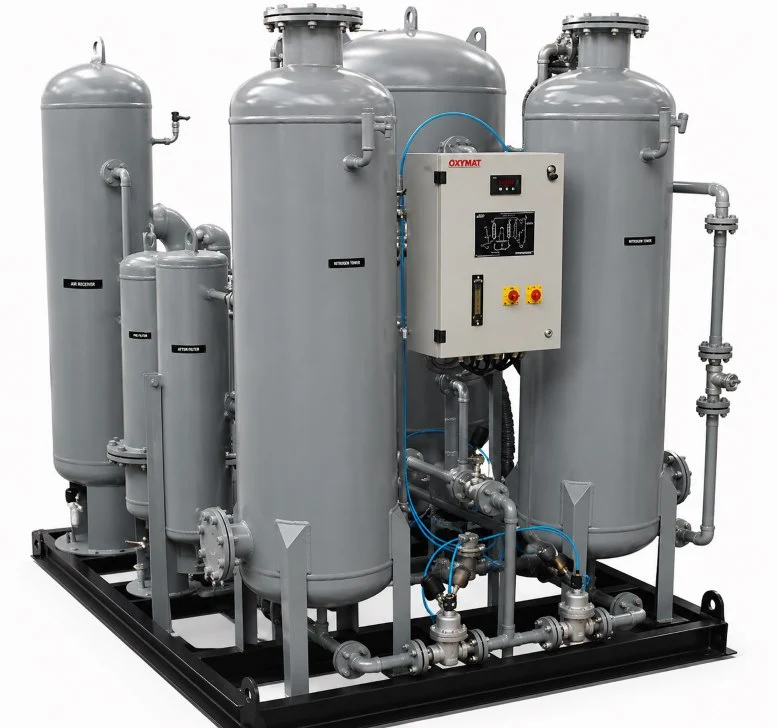
A PSA nitrogen generator also works with compressed atmospheric air, but its separation objective is essentially the reverse.
It commonly uses Carbon Molecular Sieve (CMS), which preferentially adsorbs oxygen and other molecules under controlled pressure, allowing a nitrogen-rich gas stream to be produced.
These systems are widely used for applications requiring controlled or inert atmospheres, such as food packaging, electronics manufacturing, chemical processing, metal treatment and storage applications.
Nitrogen purity requirements vary significantly by application and system configuration, so PSA nitrogen generators can be designed for different purity and flow requirements.
A commercial PSA generator (skid) is not merely a machine but a complete process engineering system.
Both systems share 90% of the same mechanical layout, piping, and valve automation; there is virtually no difference at the mechanical level.
Consequently, apart from the adsorbent material, most other components are largely identical in both systems.
Engineering Concept: This is the prime mover of the system. It draws in atmospheric air and boosts its pressure to a range of 7.0 bar (g) to 10.0 bar (g).
Technical Depth: In the PSA process, the mass transfer rate depends entirely on the inlet pressure.
Rotary screw compressors are typically used for this purpose to ensure a continuous volumetric flow rate of air without pressure pulsations.
Engineering Concept: This is a pressure vessel designed in accordance with ASME Section VIII standards.
Technical Depth: Air discharged from the compressor undergoes thermal fluctuations. This tank dampens pressure pulsations.
Additionally, it serves as a preliminary condensation vessel; as the air cools, a significant amount of water condenses into liquid form and settles at the bottom, from where it is discharged via an auto-drain valve.
To protect the chemical bed (CMS/ZMS), the air purity must meet ISO 8573-1 Class 1 standards (for oil and water). It consists of three main components:
Engineering Concept: This serves as the reaction core of the entire plant. It consists of two parallel vertical pressure vessels operating as an interconnected system.
Technical Depth: These vessels are filled with adsorbent media.
In an Oxygen Plant: Zeolite Molecular Sieve (ZMS) is used; it captures nitrogen by exploiting its quadrupole moment.
In a Nitrogen Plant: Carbon Molecular Sieve (CMS) is used; it traps oxygen molecules—which have a smaller kinetic diameter (3.46 Å)—within its pores while allowing nitrogen (3.64 Å) to pass through.
The Cycle: While Tower A performs the adsorption process (gas separation) at high pressure, the pressure in Tower B is simultaneously reduced to atmospheric levels, enabling it to undergo desorption/regeneration (self-purging).
Engineering Concept: These are the system’s mechanical actuators, controlled by a PLC.
Technical Depth: These are not ordinary valves; they are designed for high-duty cycles (hundreds of thousands of operations).
Typically, they are angle seat valves or high-performance butterfly valves with a response time of less than one second.
Their function is to switch the direction of airflow between the two towers with high precision.
Engineering Concept: This is an equalization vessel designed to stabilize the pressure and flow of the product gas.
Technical Depth: Since PSA is a batch process (where towers switch every few seconds), the output gas pressure can fluctuate.
This buffer tank absorbs pressure surges and delivers gas to the end-user or application at a continuous flow rate and constant pressure.
Engineering Concept: This serves as the automation and decision-making “brain” of the generator.
Technical Depth: It houses a Programmable Logic Controller (PLC) that processes digital and analogue signals.
Using pressure transmitters and solenoid valves, it manages the entire cycle timing (adsorption, equalization, and desorption) with millisecond precision.
Engineering Concept: This is a quality assurance and safety component.
Technical Depth: Paramagnetic or Zirconia sensors are used for oxygen, while Electrochemical or Zirconia sensors are used for nitrogen. It measures gas purity (in % or PPM) in real-time.
If the purity drops below a set limit, the PLC immediately opens the vent valve to discharge the off-specification gas and places the system in safe mode.
PSA generators are primarily used for on-site oxygen and nitrogen generation.
Both use Pressure Swing Adsorption, but the separation process and adsorbent are selected according to the required product gas.
The better option depends on gas consumption and operating requirements.
Cylinders can suit occasional or low-volume use, while PSA generation is generally considered where gas is required regularly and an on-site supply is practical.
PSA uses selective adsorption under changing pressure, while membrane systems separate gases as compressed air passes through selective membrane fibres.
The suitable technology depends on factors such as gas type, purity, flow, pressure and operating conditions.
PSA is commonly considered for on-site gas requirements where moderate production capacity and rapid operation are important.
Cryogenic separation is generally associated with very large-scale production and can achieve different purity and production requirements.
PSA-generated gases are used across industries such as manufacturing, food processing, healthcare, water treatment, metal processing, electronics and other processes requiring a controlled on-site oxygen or nitrogen supply.
The choice is determined by the process requirement.
Applications requiring oxygen enrichment use an oxygen generation system, while processes requiring an inert or nitrogen-rich atmosphere require a nitrogen generation system.
It can be, depending on the gas and required purity.
PSA system design involves a trade-off between purity, flow, pressure and energy consumption, so the required gas specification should be established before selecting a system.
Important considerations include required gas type, purity, flow rate, pressure, operating hours, compressed-air availability, environmental conditions, space, redundancy requirements and future demand.